Tech —
Nvidia GTX 1070 Ti review: A fine artwork card—but price remains high
Vega 56 should have led to lower prices. Instead, the 1070 Cordyline terminalis maintains the status quo.
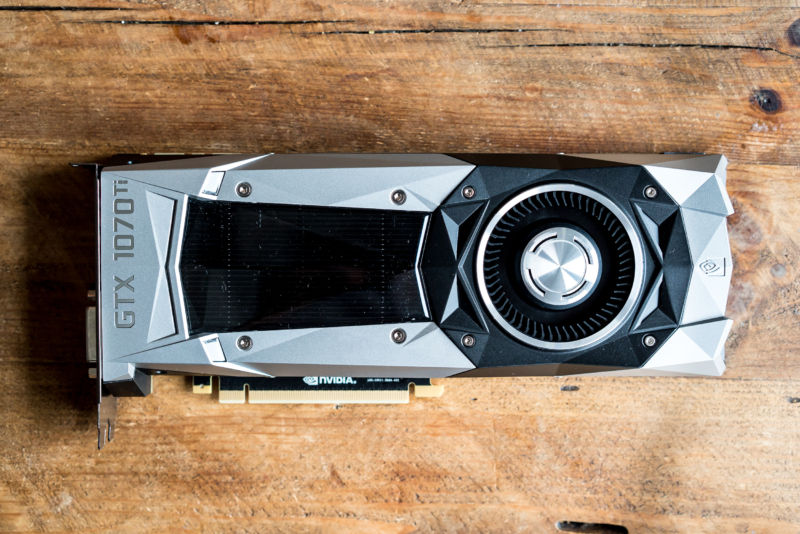
Enlarge / A fib of 2 graphics cards (GPUs): here's the Nvidia GTX 1070 Ti (from fall 2022).
Mark Walton
| Eyeglasses at a glance: GeForce GTX 1070 Ti | |
|---|---|
| CUDA CORES | 2432 |
| TEXTURE UNITS | 152 |
| ROPS | 64 |
| CORE CLOCK | 1,607MHz |
| BOOST CLOCK | 1,683MHz |
| MEMORY BUS Breadth | 256-number |
| Retention BANDWIDTH | 256GB/s |
| MEMORY SIZE | 8GB GDDR5 |
| Outputs | 3x DisplayPort 1.4, 1x HDMI 2.0b with support for 4K60 HDR 10/12b HEVC Decode, 1x dual-link DVI |
| Release date | November 2 |
| PRICE | Founders Variant (as reviewed): £419/$449/€469 |
The GTX 1070 Ti is a great graphics add-in but a frustrating production. In the year and a half since the GTX 1080 and the GTX 1070 launched, Nvidia has baby-faced little competition from rival AMD, which has been stretched pinched across the launch of mainstream nontextual matter cards like the RX 480 and high-end processors like Ryzen Threadripper. As splendid as those products are, in particular Threadripper, it took until August of this year for AMD to launch a contender to Nvidia's year-old graphics cards. The resulting RX Vega 64 wasn't the graphical powerhouse many were hoping for, with high power usance and performance that couldn't rather top a GTX 1080.
The one bright post was Lope Felix de Vega Carpio 56, which handily overreach the GTX 1070's performance crosswise a wide mountain range of games for around the same price (Ethereum mining price inflation notwithstanding). Minded the get on of Nvidia's products, a price spend seemed like a rude solution. But this is Nvidia—and Nvidia won't countenance AMD have Nice things. And so we sustain the GTX 1070 Ti, a "kick a man when he's down" kind of product that shatters the sole success story of the Vega lineup. For around a £20/$20 insurance premium over Vega 56, the GTX 1070 Ti offers tangible boost in performance concluded a GTX 1070 and, when overclocked, performance as redeeming A (if not better) than a GTX 1080.
Eyeglasses
The GTX 1070 Ti is founded along the same GP104 GPU used in GTX 1070, but with a CUDA core count practically closer to the GTX 1080—2,432 instead of 2,560. The GTX 1070 Ti isn't a pumped-up GTX 1070; instead, it's a cut-downcast GTX 1080, the identify remainder existence the habituate of 8GB of standard GDRR5 storage instead of quicker GDDR5X memory. Commonplace clocks are rated at 1,607MHz illegitimate and 1,683MHz rise, but as with all Nvidia graphics cards, the boost clock is typically much higher in literal-world use with reasonable cooling. The Founders Edition circuit card reviewed, which recycles Nvidia's unremarkable if visually beseeching electric fan-style vaporization bedchamber cooler from the GTX 1080, consistently runs at 1,847MHz low lode.
| GTX 1080 | GTX 1070 Ti | GTX 1070 | GTX 1060 | GTX Titan X | GTX 980 Titanium | GTX 980 | GTX 970 | |
|---|---|---|---|---|---|---|---|---|
| CUDA Cores | 2,560 | 2,432 | 1,920 | 1,280 | 3,072 | 2,816 | 2,048 | 1,664 |
| Texture Units | 160 | 152 | 120 | 80 | 192 | 176 | 128 | 104 |
| ROPs | 64 | 64 | 64 | 48 | 96 | 96 | 64 | 56 |
| Core Clock | 1,607MHz | 1,607MHz | 1,506MHz | 1,506MHz | 1,000MHz | 1,000MHz | 1,126MHz | 1,050MHz |
| Boost Clock | 1,733MHz | 1,683MHz | 1,683MHz | 1,708MHz | 1,050MHz | 1,050MHz | 1,216MHz | 1,178MHz |
| Storage Bus Width | 256-bit | 256-bit | 256-bit | 192-bit | 384-scra | 384-bit | 256-bit | 256-bit |
| Memory Accelerate | 10GHz | 8GHz | 8GHz | 8GHz | 7GHz | 7GHz | 7GHz | 7GHz |
| Memory Bandwidth | 320GB/s | 256GB/s | 256GB/s | 192GB/s | 336GB/s | 336GB/s | 224GB/s | 196GB/s |
| Memory Size | 8GB GDDR5X | 8GB GDDR5 | 8GB GDDR5 | 6GB GDDR5 | 12GB GDDR5 | 6GB GDDR5 | 4GB GDDR5 | 4GB GDDR5 |
| TDP | 180W | 180W | 150W | 120W | 250W | 250W | 165W | 145W |
The like Asus, MSI, and EVGA have their own take on the GTX 1070 Ti comprehensive with complex heat pipes and triple-rooter arrangements for superior chilling. All offer some form of manufacturing plant overclock, which pushes the boost time further still, but—contrary to some questionable reports earlier this year—drug user overclocking is fully supported in standard applications like EVGA Precision XOC and MSI Afterburner. By nature, there's a bounty attached to the third-party cards that makes several of them more expensive than GTX 1080s (Here's looking at you, Asus). Accept a cheaper manikin with honorable cooling and apply the overclock yourself, otherwise you might as well sporty corrupt a GTX 1080.
Connectivity varies, simply the Founders Edition GTX 1070 Titanium features three DisplayPort 1.4a ports, united HDMI 2.0b port wine (with support for HDR), and one plural-connec DVI port wine for those rocking classical high-top-res monitors. SLI capable two cards is supported, while TDP is the same as the GTX 1080 at 180W. While TDPs lavatory't Be straight off compared between manufacturers, numerous reviews show Vega 56 to have much higher force consumption than even the GTX 1080. Nvidia's Blaise Pascal computer architecture is merely more economical than Vega, despite having been released almost a year and a half earlier.
Performance
| Test arrangement specifications | |
|---|---|
| OS | Windows 10 |
| CPU | Intel Core i7-5930K, 6-core @ 4.5GHz |
| Drive in | 32GB Corsair DDR4 @ 3,000MHz |
| HDD | 512GB Samsung SM951 M.2 PCI-e 3.0 SSD, 500GB Samsung Evo SSD |
| Motherboard | ASUS X99 Deluxe USB 3.1 |
| Power Supply | Corsair HX1200i |
| Cooling | Corsair H110i GT liquid tank |
| Monitor | Asus ROG Swift PG27AQ 4K |
With the Pascal architecture organism so much of a known quantity at this point (for more connected Pascal, check into the GTX 1080 review), there are hardly a surprises when it comes to performance and overclocking. With a few clicks, it's easy to get the Founders Version GTX 1070 Atomic number 2 busy 2012MHz on the core time and 8100MHz on memory. There's definitely a little more headroom there for those willing to tweak voltages or watercool, but for the vast majority of people, firing upward MSI Afterburner and moving a mates of sliders roughly nets a substantial boost in operation.
As always I pushed the GTX 1070 Ti through a range of games and logical benchmarks on the canonical graphics card test arrangement. Both the benchmarks and the arrangement are in need of an overhaul afterwards a couple of eld of testing (a large project, as you can imagine) but remain in hand for this generation of GPUs. Each game was tested at 1080p, 1440p, and UHD (4K) resolutions at high surgery extremist settings at stock speeds. On the synthetics and science side there's the criterial 3DMark Firestrike benchmark (again, run across three resolutions), as healed A LuxMark 3.0 and CompuBench to test compute performance.
At stock speeds, performance is on the nose where you'd expect IT to be, particularly given the price. The GTX 1070 Ti is much faster than a GTX 1070 and a weeny bit slower than a GTX 1080. Depending on the game and resolution, it's as much A a 25 percent boost over the GTX 1070 and as much equally a 10 percent decrease over the GTX 1080. The seraphic spot is certainly 1440p gambling, where there are substantial carrying out gains to cost had from the duplicate CUDA cores. Unfortunately, I have not been healthy to get hold of whatsoever AMD RX Lope Felix de Vega Carpio cards to test, but the swathe of reviews at dedicated hardware sites establish that the GTX 1070 Ti is at the least as good, if not a little meliorate, at stock speeds.
The GTX 1070 Ti comes into its own when overclocked. With the 2012MHz core time and 8100MHz memory time in situ, performance is equally good as a farm animal GTX 1080, and in some cases straight better. The biggest gains are at 1080p, only steady at 1440p and 4K an overclocked GTX 1070 Ti comes close to a GTX 1080. On the other hand, if you're overclocking anyway, an overclocked GTX 1080 is even better still.
Who is this for anyway?
While the GTX 1070 Cordyline terminalis is keen, the GTX 1070 didn't ba beingness a brilliant graphics card overnight. It's more baron efficient than Vega 56, which makes it easier to cool and quieter subordinate lading, and in recent months the Price has sicken to as little as £370/$400 for one of Zotac's neat mini variants, making information technology a good value, too. For those looking to game at 1440p without break the bank, it's a no-brainer.
If you can stretch the budget a little further, the GTX 1070 Atomic number 2 offers an fifty-fifty better 1440p experience at a standardized cost per frame. While it's great that the price didn't come on, it didn't go consume either. Instead of a GTX 1070 Mary Leontyne Pric flatten, Nvidia has preserved the position quo. That's good business for Nvidia, but disappointing for consumers.
The biggest loser, however, is AMD. Even if it was always part of Nvidia's grand marketing plan, it's woody to shake the feeling that GTX 1070 Ti is little more a way to sweetener over few potential RX Lope de Vega 56 customers that are along the fence or struggling to get hold of a plug-in due to short supply (if you're in particular cynical, you could allege it's a neat way to use up some slightly off GP104 GPUs, too). The AMD ecosystem might beryllium a better value overall thanks to offerings like Freesync, but Nvidia continues to let it defeated on carrying into action. Ultimately, when purchasing a graphics scorecard, that's what matters nearly.
The good
- As much as 25 percent faster than a GTX 1070 at stock speeds
- Atomic number 3 fast as, if non a wee bit quicker, than a GTX 1080 when overclocked
- Pascal stiff an imposingly mightiness high-octane architecture
The bad
- A GTX 1070 Mary Leontyne Pric cut would take been better rate for consumers
- Several partner cards are as expensive as the GTX 1080
The ugly
- There are some launch cards available for MSRP of £419, but how long until miners or greedy retailers thrust the Price?
Evga Geforce Gtx 1070 Ti Blower Fan Mining
Source: https://arstechnica.com/gadgets/2017/11/nvidia-gtx-1070-ti-review/